
14 Mar Radon in Pennsylvania
A practical guide for York & Lancaster County homeowners and buyers
Radon is one of those home topics that isn’t exciting—until it matters. It’s an invisible, odorless gas that can build up inside homes, and long-term exposure increases lung-cancer risk. Nationally, radon is considered the second leading cause of lung cancer after smoking. (CDC)
Here’s the local twist: Pennsylvania has a serious radon problem. The PA Department of Environmental Protection (DEP) estimates that roughly 40% of homes tested in Pennsylvania have radon levels above the EPA action guideline. (Pennsylvania.gov)
This guide breaks down:
- when to test,
- how to interpret the results,
- what mitigation really looks like,
- and how to handle radon during a home purchase—without drama or hype.
What radon is (and why PA sees higher levels)
Radon comes from the natural breakdown of uranium in soil and rock. It can enter a home through tiny openings—cracks in foundations, gaps around sump pumps, crawlspaces, and utility penetrations. The EPA’s radon zone map flags broad areas where elevated indoor radon is more likely, but the key takeaway is simple: the only way to know your home’s radon level is to test. (US EPA)
Here’s a simple visual of how radon can move from soil into a home.
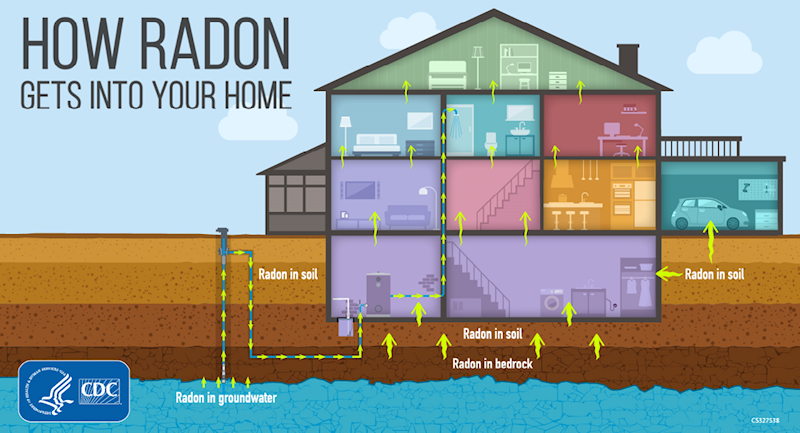
Figure: How radon gets into your home. Source: CDC.
When to test your home for radon
Testing is smart in a few common situations:
- If your home has never been tested
- When you’re buying or selling
- After major renovations (especially finishing a basement or changing HVAC/ventilation)
- If you start spending more time in a lower level (home office, bedroom, playroom)
- After a mitigation system is installed (to confirm performance)
CDC guidance strongly supports testing (and re-testing after changes) because radon levels can vary over time. (CDC)
How radon testing works (simple, practical)
There are two main approaches:
Short-term test
Typically a few days. Great for quick screening (and common in real estate transactions).
Long-term test
Runs for months and gives a better picture of the year-round average.
During testing, “closed-house conditions” are usually recommended (windows closed except normal entry/exit) so results reflect typical indoor buildup. Follow the kit instructions or your professional tester’s protocol.
DIY kit or professional test?
Both can work. If you hire someone, Pennsylvania requires DEP certification for people performing radon testing/mitigation services (with specific exemptions). When you’re in a transaction, using a certified professional is usually the cleanest path. (Pennsylvania.gov)
Understanding your radon results (what the numbers mean)
Radon is measured in pCi/L (picocuries per liter).
The EPA action level: 4.0 pCi/L
- The EPA recommends fixing a home if the radon level is 4.0 pCi/L or higher.
- The EPA also recommends considering a fix if radon levels are between 2.0 and 4.0 pCi/L, because there is no known “completely safe” level. (US EPA)
What to do next (a clear decision path)
Pennsylvania’s radon guidance follows the same general approach:
- Take a short-term test
- If the result is 4.0+ pCi/L, do a follow-up test (short-term or long-term)
- Mitigate if the confirmed result remains elevated (Pennsylvania.gov)
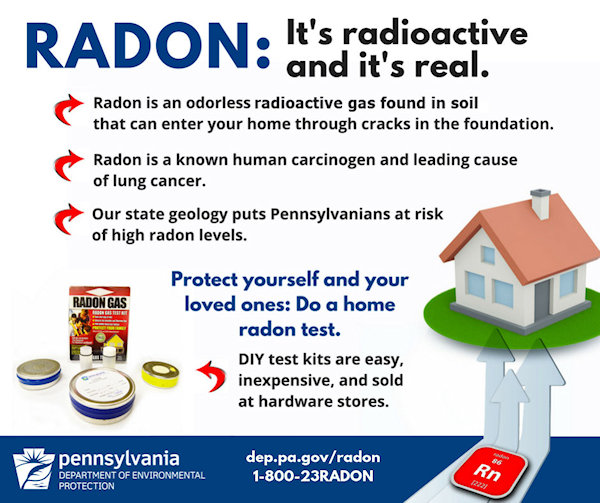
Figure: Radon testing reminder and basic facts. Source: Pennsylvania Department of Environmental Protection (PA DEP)
What mitigation looks like (and what it doesn’t)
Most radon mitigation in single-family homes uses a proven method that pulls radon from beneath the foundation and vents it safely above the roofline. It typically includes:
- a small fan,
- PVC piping,
- and a clearly labeled system installed by a qualified professional.
A few important truths:
- Sealing cracks alone usually isn’t enough. It can help, but it’s rarely the full solution.
- Mitigation is usually straightforward. Most installs are not major construction projects.
- You still re-test. After mitigation, testing again is how you confirm the system is doing its job. (US EPA)
Radon during a home purchase (York & Lancaster County)
Radon is common enough in PA that it shouldn’t automatically scare buyers away. What matters is how cleanly it’s handled.
For buyers
A simple, practical approach:
- Request a radon test during inspections.
- If results are elevated, negotiate mitigation (or equivalent concession) as part of repairs/credits.
- Confirm the system is installed by a qualified pro and re-test after mitigation.
For sellers
If you suspect radon might come up:
- Consider testing before listing so you control the timeline.
- If mitigation is needed, it often reduces uncertainty for buyers and can help keep negotiations calm.
If you’re currently house-hunting, you can keep your search moving while still being smart about health and safety: [Start your home search].
If you’re deciding whether to list this spring, a clean baseline helps: [Get a free home value report].
Local “PA home” factors that can affect radon
York and Lancaster County homes often have basements, and seasonal patterns can affect airflow and pressure differences (especially late winter into spring). A few homeownership tips that pair well with radon awareness:
- keep downspouts extended away from the foundation,
- manage basement humidity,
- and pay attention to sump pump areas and foundation penetrations.
Those steps don’t replace mitigation when levels are high—but they support overall basement health.
FAQ: Radon in Pennsylvania
Do newer homes have radon?
They can. Newer construction can be tighter, which sometimes allows radon to accumulate if it enters the structure. Testing is still the rule.
If my neighbor’s test was low, do I still need to test?
Yes. Radon can vary significantly from house to house—even on the same street. (US EPA)
Is radon only a “basement problem”?
Basements often test higher, but radon can affect any level. You test the lowest lived-in level per standard guidance. (CDC)
What is the action level again?
Fix at 4.0 pCi/L or higher; consider fixing 2.0–4.0 pCi/L. (US EPA)
Does mitigation hurt resale value?
In PA, mitigation is common. Many buyers see a properly installed system as a normal, solvable item—especially when it’s documented and re-tested.
How often should I re-test?
Re-test after mitigation and after major renovations or lifestyle changes that increase time spent in lower levels. Periodic re-testing is also a smart habit. (CDC)
Bottom line
Radon is common in Pennsylvania, but it’s also manageable. Test, interpret the results correctly, and mitigate when needed. That’s how you keep this from becoming a scary mystery and turn it into a straightforward checklist item.
If you’re buying or selling in our area and want help building a clean plan around testing, negotiations, or timing Contact Us!
No Comments